OTHERS
THE LAND OF THE BHUTAS: RITUAL AND SOCIETY IN SOUTH KANARA
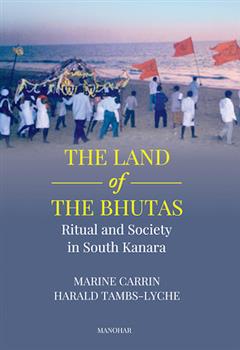
South Kanara’s remarkable cultural diversity developed under Jain kings, who relied on the Bunts, a dominant caste of landholders, to maintain power. The religion of the Tulu speakers differs from mainstream Hindu pantheon; it revolves instead around the bhutas, deities specific to the region. While the cult of the ‘royal’ bhutas reinforced the chiefs, all bhutas manifest themselves through possession of low caste mediums, dispensing justice and truth that transcend society hierarchies.
The Billavas, tenants of the Bunts, were once seen as untouchables, but have redefined their identity through the cult of the twin bhutas Koti and Chennaya, thereby challenging the dominance of the Bunts. The Mogavera fishermen have similarly risen from their former status; although their goddess temples are now undergoing Sanskritisation, the cult of their caste bhuta Bobbariya continues to unite them. Despite persistent discrimination, bhutas associated with the lower castes are revered even by the higher castes, revealing a complex interplay of power, devotion, and hierarchy.
Along the coast, Muslims, Gauda Saraswat Brahmins and Catholics – dominate in towns and trade – did not integrate hierarchically but coexisted in a mosaic of interdependence.
This anthropology of South Kanara argues that such coexistence has forged a distinctive regional cosmopolitanism, sustained by a ritual discourse that transcends sectarian boundaries while anchoring each community’s sense of belonging and historical experience in the shared matrix of the region. About the Author Marine Carrin, Director of Research Emeritus at CNRS, Toulouse is a leading anthropologist known for her pioneering work on indigenous and tribal communities in India. She is the author of three major monographs on the Santals and co-editor of key archival texts on their society and culture. As a general editor of Brill’s Encyclopedia of the Religions of the Indigenous People of South Asia (2022), she has shaped contemporary scholarship on ritual and society in South Kanara.
Harald Tambs-Lyche is Professor Emeritus at the University of Picardie, France. His research spans caste, ethnicity, and popular Hinduism in Gujarat and South Kanara. He has conducted extensive research on Patidars in London, the historical and contemporary society of Saurashtra, and the Gauda Saraswat Brahmins of South Kanara. His theoretical essay, ‘Transaction and Hierarchy’, remains a significant contribution to the study of caste in India.
Some more books of similar interest